Home / Liquid cooling / Rear door heat exchangers
Rear door heat exchangers for dense GPU racks
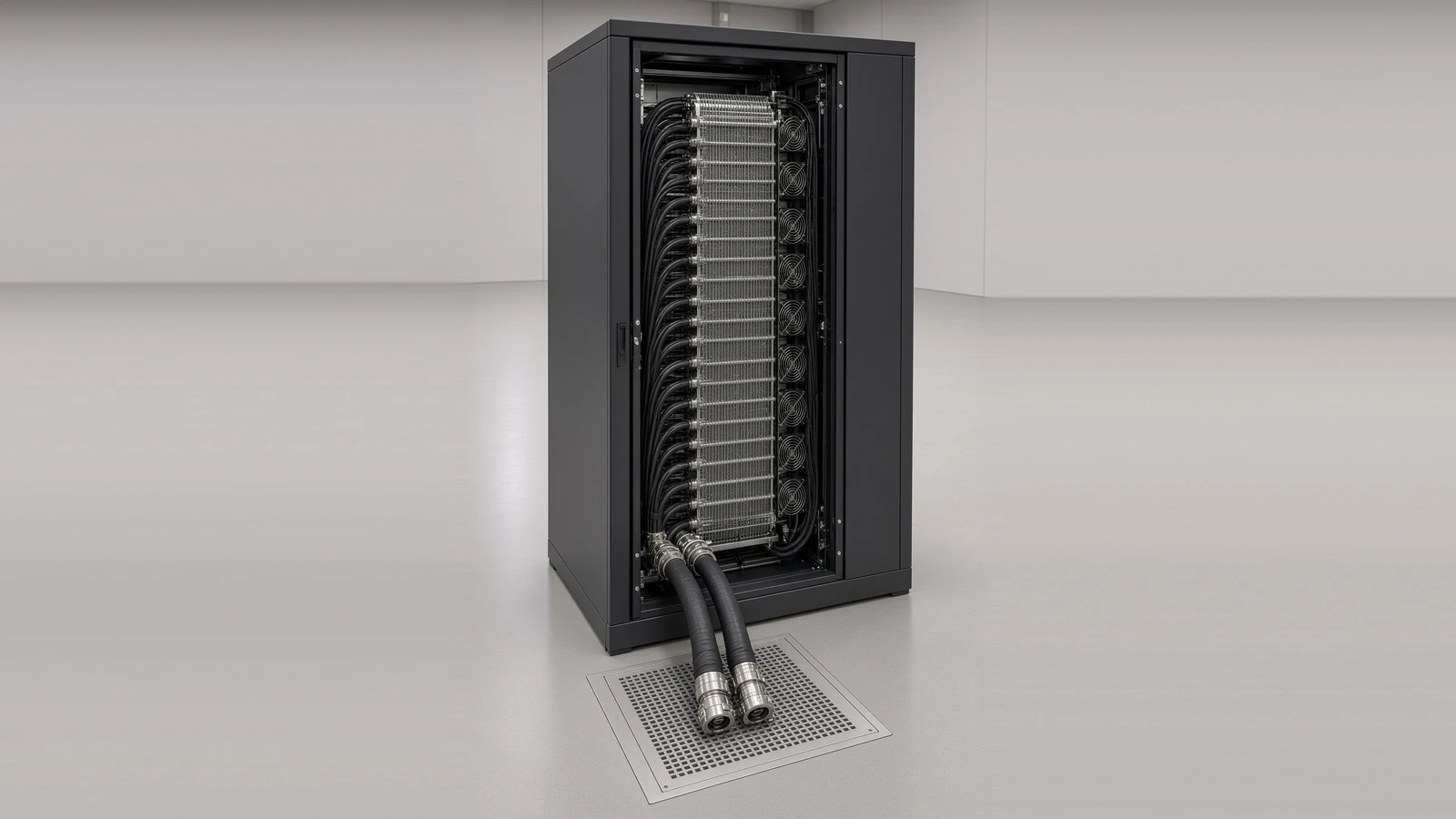
A rear door heat exchanger replaces the back door of a rack with a coil. Hot air from the servers passes through it and leaves close to room temperature. It is often the simplest way to raise density in an existing room.
01
What it is
A coil that replaces the rack's rear door. Server fans push hot air over it, coolant in the coil takes the heat, and the air leaves at about room temperature.
Passive versions rely on server fans; active versions add their own. The coolant supply comes from facility water or a dedicated chilled loop.
02
Who it is for
- Existing rooms with standard racks.
- Air cooled servers running at higher density, and sites that want to avoid changes inside the servers.
- Inference and edge sites where several nodes share a small room.
- Enterprise private AI in existing comms rooms, where facility water is rare.
- Engineering and simulation teams with a few dense racks in an existing room.
How it works
- 01
Replace the door
The rack's rear door is swapped for a door carrying a coil and coolant connections.
- 02
Air over coil
Server fans push hot exhaust air through the coil. Active versions add fans of their own.
- 03
Air leaves cool
The coolant takes the heat away; the air returns to the room at about room temperature.
04
Where it fits
- Existing rooms with standard racks.
- Air cooled servers running at higher density.
- Sites that want to avoid changes inside the servers.
05
Things to check
- Rack compatibility: door size, hinge and depth.
- Coolant supply: facility water or a dedicated chilled loop.
- Passive or active, and the power for active fans.
- Floor loading with the extra weight of the door and water.
- Maintenance access behind the rack.
06
What we can supply
- Passive rear door heat exchangers.
- Active (fan assisted) rear door heat exchangers.
- Matching racks where needed.
- Hoses, fittings and associated CDUs (see CDUs).
Specifications are provided with your quote, and datasheets are available on request. Stock and availability on application.
Related GPU systems. Multi GPU rack servers in air cooled configurations, and PCIe GPUs and workstations installed in dense servers.
Images are illustrative and do not show specific products.
How we work
Five steps, whether the request is for GPU systems, cooling, or both. Each enquiry carries a reference from receipt, and nothing is agreed until a written quote is accepted.
- 01
Scoping
We confirm workload, configuration, quantity and site constraints before anything else.
- 02
Configuration and validation
We check the bill of materials, power, cooling and interconnect fit before quoting, and check the system against the cooling and power you have or plan.
- 03
Sourcing
We source the configuration and confirm details in the written quote.
- 04
Compliance and checks
Sanctions, export control, end use and know your customer checks before any quote is final.
- 05
Logistics and delivery
We arrange delivery to your site and confirm the terms in writing.
08
Related questions
C05What is a rear door heat exchanger?
A coil that replaces the rack's rear door. Server fans push hot air over it, coolant in the coil takes the heat, and the air leaves at about room temperature. Passive versions rely on server fans; active versions add their own.
C03Can liquid cooling be added to an existing room?
Often, yes. Rear door heat exchangers fit standard racks, and liquid-to-air CDUs reject heat into the room without facility water. Direct-to-chip with facility water usually needs pipework and a plan for the room.
C02Do GPU servers need liquid cooling?
Not always. Many configurations are available air cooled. Denser nodes and rack scale systems are increasingly designed for liquid, and some are only offered that way. It depends on the configuration; we confirm this in the quote.
Q14Can you quote GPU systems and cooling together?
Yes. That is the point of offering both. Choose "GPU systems and cooling" on the contact form, tell us about the site, and one written quote covers the systems and the cooling equipment. See Cooling.
Related pages
Liquid cooling
Direct-to-chip, CDUs and rear door heat exchangers, for dense racks.
Direct-to-chip liquid cooling
Cold plates on the hottest parts, with coolant carried through manifolds in the rack.
Coolant distribution units
Keep the facility loop and the server loop apart, and manage flow, temperature and filtration.
GPU servers
GPU servers, rack scale GPU systems and PCIe GPUs.
Quote rear door heat exchangers with your GPU systems
One written quote can cover the systems and the cooling. Tell us about the site and we will scope both.